
Death Records are the first step for families and researchers needing a certified copy quickly. A death record search can be run online through state vital statistics portals, revealing the decedent’s name, registration number, cause and manner of death. Fees vary by jurisdiction, and most agencies accept a credit card for the death certificate request. Knowing the required identification reduces delays and ensures you receive the official death record without surprise.
Death Records also dictate who may obtain a certified death certificate, typically immediate family or legal representatives with proper ID. Texas vital statistics privacy laws keep medical details sealed, yet public death records by county are searchable after 25 years. If errors appear, a death record amendment requires supporting documents and a modest fee. Understanding these guidelines helps resolve missing or duplicate entries and speeds the retrieval of the correct death certificate copy.
How to Search Death Records
Death Records are official registrations of a death and the facts certified when the event was registered. To assist researchers, official death index documentation shows that a death record search helps locate a matching entry, check the decedent’s identity, and find the registration or certificate number used by the issuing office. The main goal is to identify the correct record and request the right document, often a certified death certificate for a family, legal, insurance, property, or research purpose. A search result or historical index does not by itself serve as a certified copy.
Official Search Portal: https://clerk.kanecountyil.gov/VitalRecords
Steps to Search
- Open the official Kane County Clerk page and locate the death-record search or request option.
- Confirm where the death occurred. The event location, rather than the person’s residence, points to the office responsible for the original filing.
- Collect the decedent’s full legal name, date of death, and place of death. Add sex, date of birth, time of death, and a registration or certificate number when known.
- Follow the page’s search or request link. Compare each result by name, event date, event place, and assigned number before requesting a document.
- Choose the document type shown on the official page, review the current fee and payment instructions, and keep the confirmation or receipt.
A Kane County search concerns a death that occurred in Kane County, Illinois. A death in another state, foreign country, or another Illinois county belongs with the office for that place. The Kane County page covers birth, death, and marriage records, so choosing the death category prevents a request from being filed under the wrong record type.
Death Record Details and Causes
A death record combines the legal registration of a death with facts supplied by the funeral home, certifying physician, medical examiner, coroner, and other participants in the case. These details support estate settlement, insurance claims, benefit requests, property transfers, genealogy research, and official record matching. Some fields become final at registration, while medical details may remain under review or receive later amendments.
Decedent Identity and Registration Number
Start with the fields most likely to separate one person from another. A full legal name, date of death, and place of death form the basic search set. Sex, date of birth, parents’ names, and a known record number can resolve an unclear match. The place of death may list a county and state rather than a street address, and the date of death may differ from the date on which the certificate was filed.
Immediate Family and Eligible Requesters
Illinois places confidentiality limits on recent death certificates. A requester normally must show a qualifying relationship or legal authority. Common qualifying relationships include a spouse, parent, child, sibling, grandparent, or grandchild of the deceased. An attorney, executor, administrator, guardian, or other person acting for a qualifying relative may request a copy when documents prove that role. A funeral home or funeral director may also order a copy for a permitted purpose.
Prepare a signed application, proof of identity, and documents that establish the relationship or authority. A current government-issued photo ID is commonly requested. A marriage certificate, birth certificate, letters of administration, guardianship papers, or comparable records may support a relationship or legal role. People asking on behalf of a minor or an absent relative may need additional proof. The issuing agency makes the final eligibility decision under the rules that apply to the request and the date of death.
Cause, Manner, and Medical Certification
Cause of death describes the disease, injury, or condition that led to death. The cause may include a chain of conditions, with the underlying cause listed as the disease or injury that started the sequence. Manner of death classifies the event as natural, accident, suicide, homicide, undetermined, or pending. These fields answer different questions and should not be treated as interchangeable.
A physician certifies most deaths. A medical examiner or coroner handles cases assigned to that office and sets the cause and manner within their legal duties. Some records list the cause or manner as pending until the review is complete. A later certified copy can reflect an amendment after the medical review ends.
Official Certificates and Amendments
A database match, a plain copy, an archival image, and a certified death certificate have different legal uses. A certified copy is issued through the office that holds the registered record and carries that office’s authentication. Agencies receiving the copy may require a signature, seal, or other proof of certification. A search result can identify an event, but it does not carry those authentication features.
Required Identification and Processing Fees
Every request needs enough detail to locate the event and enough evidence to establish the requester’s right to receive the document. The Kane County Clerk page controls the current fee for a Kane County request. Fees can differ by record type, request method, document format, and special handling, so check the amount shown on the official page before payment. Any separate search, copy, amendment, or rush charge should be read on the same official page or checkout screen.
The office may request the applicant’s photo ID, a signed application, the decedent’s full name, the date and place of death, and proof of relationship or authority. Payment methods and delivery choices also vary by request route. Keep a receipt or confirmation number, especially if the record must be mailed.
Correcting Errors and Submitting Amendments
An issued certificate with an incorrect name, date, place, or other entry should be corrected through the custodian. Do not write on the certificate, cross out a field, or create a replacement by hand. A correction request must describe the error and show what the correct entry should be.
Supporting documents can include the funeral home’s worksheet, hospital or medical records, physician certification, a certified birth or marriage certificate, identification, or court papers. The office decides which proof is needed for the specific error. A copy of the original certificate may be requested with the correction request.
Public Availability and Confidentiality
Illinois applies different confidentiality rules to death records according to the age of the event and the status of the file. To assist researchers, official obituary records documentation shows that the public-availability period for a death certificate is 25 years after the date of death. Before that period ends, eligibility and identification rules apply. Public availability after 25 years does not turn a database entry or archival image into a certified copy.
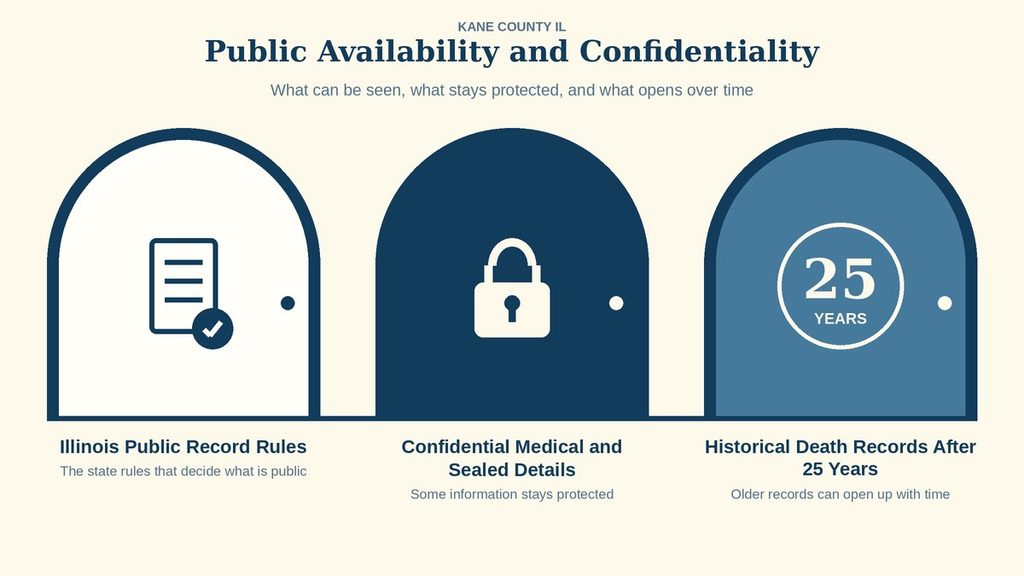
Illinois Public Record Rules
- A death that occurred less than 25 years ago is subject to Illinois confidentiality rules. The requester normally must show a qualifying relationship, legal authority, or another approved basis.
- Once 25 years have passed since the date of death, the contents of the death certificate may be available to the public under Illinois law. Current agency rules should still be checked before ordering.
- The 25-year rule applies to death certificates. Birth certificates, marriage records, divorce records, and court files follow separate rules.
- Public availability does not change a search result into a certified copy. The custodian’s authentication remains necessary when the recipient requires legal certification.
- Older records may appear in an index without the full certificate. Coverage can depend on the years, counties, and record types held by that source.
Confidential Medical and Sealed Details
Recent death certificates can contain facts that the requester is not entitled to receive. Online indexes may also omit cause, manner, or medical details based on the record’s age and filing status. A cause entered on a certificate should not be confused with the complete medical file used to determine it.
A record described as sealed may be restricted by a court order, a pending agency review, or a separate release rule for medical records. The label alone does not identify the reason for the restriction. The family can request the certified certificate, and the issuing agency can explain which details are available from that particular record.
Historical Death Records After 25 Years
For a death at least 25 years old, the public can request the certificate’s contents under Illinois rules. The Illinois State Archives may hold historical indexes or record images, while county offices may hold older local records. The Illinois Department of Public Health handles death records through the state registration system. The best source depends on the year, county, and whether a certified copy or historical research image is needed.
Historical indexes often work by surname, first name, death year, and county. They may not list a place of death, certificate number, or complete family names. Once the correct entry is found, request the document from the custodian that can issue the required version. A genealogy index can narrow the search, but it does not establish that a file is complete or certified.
Record Accuracy and Missing Results
A missing search result can stem from a name variation, the wrong jurisdiction, an incomplete file, pending medical review, or the coverage limits of the index. It does not prove that the death was never registered. A careful search starts with the event facts and checks each returned entry before deciding that no record exists.
Distinguishing Similar Name Matches
One name can appear several times in a death index. Use the date of death, place, sex, date of birth, parents’ names, and registration number to separate the entries. Search with a surname and a broad year range before narrowing the results. Nicknames, shortened middle names, spelling changes, and married or maiden surnames can all affect the match.
Never combine details from two different entries to create one identity. Record the registration number for each plausible match and compare it with any certificate, letter, or claim file. If two entries describe the same person with different numbers, the issuing custodian must determine whether one is a duplicate, an amended record, or a separate event.
Multi-Jurisdiction Filing and Delays
The place of death controls the original registration even when the decedent lived in another county or state. A hospital near a county line, a residence in another jurisdiction, or a medical examiner case can involve several offices. The certificate may pass from the funeral home or coroner to the local registration office and then into the state system.
A delay can occur while a cause of death awaits medical review or while the certificate moves between offices. Search by both the date of death and a filing-year range. A record created after the event may carry a later creation date. This process does not change the legal event date, so both dates matter during a search.
Unlisted Death Record Resolution
If no entry appears, widen the name and date search, check the place of death, and confirm that the source covers the correct years and county. If the record remains missing, request a records check from the official custodian and provide the strongest available identity details. Do not order through a third-party site until the responsible office and record number are confirmed.
Death Records and Related Record Sources
Several sources can mention the same person without proving the same event. A death certificate is the legal registration of a death. An index locates that registration, an obituary reports a death to the public, and a cemetery record documents burial. Each source has a different purpose, custodian, and level of authentication.
Choosing the Right Office for a Death Record Request
The correct source follows the location of the event and the age of the record. Starting with the wrong agency can create duplicate requests and extra fees. Use the following routing rules before submitting an application.
- For a death that occurred in Kane County, start with the Kane County Clerk death-record service or the request path linked on its official page.
- For a death in another Illinois county, use the local registration office or the statewide ordering path operated by the Illinois Department of Public Health.
- For a death outside Illinois, use the civil registration office for the state, territory, or country where the death occurred.
- For a case under medical examiner or coroner review, contact the responsible medical office or the local registration office handling the pending case.
- For historical research, check the Illinois State Archives or the custodial county archive when the event falls within their holdings.
Verify a Death Certificate
Check each copy before sending it to an agency, insurer, court, funeral home, cemetery, or other recipient. A few minutes of review can prevent a rejected filing caused by a name error, wrong document type, or outdated certification.
- Compare the decedent’s full name, date of birth, date of death, and place of death with the supporting facts.
- Confirm that the record covers the place where the death actually occurred.
- Record the registration number, certificate number, issue date, and any file or transaction number shown on the copy.
- Verify that the document is a certified copy when the recipient requires government authentication.
- Check for an amendment notation and confirm that any changed name, date, place, cause, or manner matches the approved correction.
- Confirm the fee and payment method shown by the official issuer, then retain the receipt or confirmation.
- Make sure the document remains readable and complete. A certified copy with missing pages or an altered seal may be rejected.
- Ask the recipient which version it accepts before ordering additional copies, since some agencies request originals or reject plain copies.
Contact Information
Use the official Kane County Clerk page for the current request steps, fee amount, payment methods, and office locations. Review the instructions before submitting a request to avoid missing documents or incorrect payments. Processing times and accepted payment options may vary depending on the record type. Check the latest office notices for changes to public hours or service availability. Contact the Clerk’s Office directly if any request requirements remain unclear. The main office details are:
- Main office: 719 S. Batavia Ave., Building B, Geneva, IL 60134
- Phone: 630-232-5950
- The official page also lists separate Aurora and Elgin office locations.
Frequently Asked Questions
Death records are official documents that confirm a person’s passing. Accessing them helps families settle estates, claim benefits, and verify genealogy. Most states keep these files in a vital records office, and many allow online searches. Knowing how to locate a death certificate, what fees apply, and who may request the record saves time and avoids costly mistakes.
How can I search death records online for a specific person?
Start at the state’s vital records portal or a trusted database such as the Kane County Clerk site. Enter the decedent’s full name, approximate death year, and any known location. The system returns matching entries with a record number and certificate status. Review the details, then follow the on‑screen prompts to order a certified copy or request further verification.
What information is needed to request a death certificate?
You must supply the decedent’s full name, date of death, place of death, and your relationship to the deceased. Include a government‑issued ID and a completed request form. Some offices require proof of need, such as a court order or insurance claim. After submission, expect a processing window of 7‑14 business days for standard requests.
Can I obtain a death record by record number instead of name?
Yes. If you have the record or certificate number, enter it into the search field labeled “Record Number” on the official website. This method bypasses name variations and returns the exact document instantly. It is especially useful when the name appears with alternate spellings or middle initials.
What are the fees and turnaround times for a certified death certificate?
Fees range from $10 to $25 per copy, depending on the jurisdiction. Expedited processing adds $5‑$10 and reduces delivery to 2‑3 days. Standard service usually costs $12‑$15 and arrives within 7‑14 days. Payment can be made by credit card, check, or money order; keep the receipt for future reference.
Who is authorized to request an official death record?
Immediate family members, legal representatives, and persons with a documented need (e.g., insurers, attorneys) may request a certified copy. Some states allow anyone to view basic death index information, but a full certificate requires proof of relationship or a legitimate purpose. Submit the required ID and a brief statement of why you need the record.